SCIENCE COOKIES
Science articles with chocolate chips
The science of falling in love
Published: 15/8/2020
Author: Paulina Vargas

If you have had the happiness (or misfortune for some) of falling in love, you will know very well that it is a very difficult experience to explain; sometimes your mind and body act in ways you don't plan and you feel mixed feelings that keep you awake. Despite the fact that all this is triggered by aspects of a psychological nature, there is a biological and chemical explanation capable of specifying much better what is happening behind all this phenomenon.
The process of falling in love is commonly divided into 3 stages, due to the fact that in each of them the body experiences different phenomena. But something they have in common is that they all take place in the brain, since love could be defined as a neurological process in which parts such as the hypothalamus, the amygdala, the prefrontal cortex, the nucleus accumbens and the frontal tegmental area collaborate. Then, saying that you love someone with your heart, ends up being something illogical.
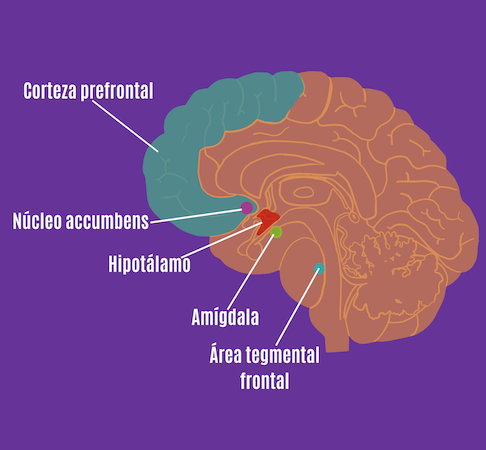
Parts of the brain that collaborate in the neurological process of falling in love.
The stages of love in the brain
The first of these stages is desire, which begins practically when we begin to feel an attraction for someone, when we get a new 'crush', for example. The brain immediately perceives what is happening and begins with the secretion of pheromones and sex steroid hormones in both men and women, which are testosterone and estrogens.
When we begin to have the suspicion or even the certainty that that special person could reciprocate lovingly, the second stage is triggered, which is known as attraction . Which causes the release of chemical compounds called monoamines, among which are dopamine, serotonin, phenylethylamine and norepinephrine.
Not all lovers get to experience the third and final stage, called affection or attachment, since it is usually achieved until after a period of time of having started a stable relationship. From this stage, oxytocin, vasopressin and endorphin take over.
Now you are probably wondering what are all those chemical compounds and what do they cause?
Love is symptomatic
I think that it has happened to almost all of us that when we finally get up the courage to talk to them or even send a message to our crush, we get nervous, we think a lot about the words we will say, and our hands can even get sweaty and our voice shake. This is completely normal, because when we are in the first stage of love, the body tends to relate what happened to a stressful situation.
Something related to the effects of the second stage is the phrase "love is like a drug", and it is actually not that far from reality, because both drugs and falling in love produce high levels of dopamine, which generates a constant euphoria, desire, dependence and withdrawal in both scenarios; and because of that, after a while of interacting with that special person, we realize that we are excited to see them, that our heart rate accelerates when we are with them and that, without meaning to, we cannot concentrate because we always have them in our thoughts. To this are added the effects of serotonin, which affects our mood making us feel happy when we are with that person or sad when we are not; and also those of norepinephrine, which in addition to causing insomnia and loss of appetite, increases our ability to remember new stimuli, making us remember the smallest details of when we meet that person.
In the stage of affection, the effects of vasopressin and oxytocin cause the intense and excessive love, which we felt in the second stage, to decay so that a feeling of attachment takes place. Vasopressin helps the attachment to last and oxytocin, nicknamed the 'hug chemical', causes a closer emotional bond to be created through physical contact. Likewise, a feeling of calm and stability is generated with the other person thanks to the endorphin, since the extra doses of this substance reduce pain, making even the most insignificant things cause us joy.
One of the most representative symptoms of love are the so-called 'butterflies in the stomach', which are like a tingling in the abdominal area that is detonated when seeing that loved one. This usually occurs in the second stage of love, but not strictly, and unlike all the symptoms previously mentioned, it is not caused by the release of a chemical substance alone.
What really are butterflies in the stomach?
It all starts in the autonomic nervous system (ANS), which is divided into the parasympathetic ANS and the sympathetic ANS; The first being the one that slows our heart rate and makes us feel relaxed, and the second the one that is activated in just a few milliseconds to secrete adrenaline and cortisol when the body feels in danger. The change from one ANS to another is the exact reason for this turmoil that we feel in the stomach; This state of nervousness, uncertainty and worry, perhaps caused by a first date, is interpreted by the body as a situation that puts us at risk. And when changing to the sympathetic ANS, a certain amount of the blood that was in our digestive system is transferred to the muscles of the arms and legs, as they are ideal to escape from a situation of real danger; our stomach realizes the lack of blood and oxygen, and sends that stimulus that we feel like a flutter of butterflies in protest.
Without a doubt, falling in love involves many temporary changes in our body, which biology and chemistry are able to explain; However, there are no strict rules when falling in love, since questions such as why we fall in love and how much we can fall in love with someone, are things that exact science cannot cover, since the sentimental part of love is still very abstract for science.
References
https://www.codigonuevo.com/entretenimiento/explicacion-cientifica-sientes-mariposas-estomago
https://www.nationalgeographic.es/ciencia/que-le-pasa-tu-cerebro-cuando-te-enamoras
Advertising






Advertising