
SCIENCE COOKIES
Science articles with chocolate chips
Venus: Earth's evil twin
Published: 4/8/2020
Author: Paulina Vargas
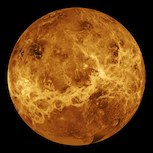
Image Credit: NASA.
When we think of Venus, we immediately associate it with the goddess of love, fertility and beauty in Roman mythology, and we wonder what is so special about the second planet in the solar system to be named as its best goddess? In reality, the Romans did not know much about this planet, they only named it that way for being beautiful, and for standing out to the naked eye on our clear nights. But, there is so much about Venus that if the Romans had known, I highly doubt they would have named it after their best goddess.
For a long time it was believed that Venus was a planet with the potential to host life, as it has structural characteristics very similar to those that make up the earth, hence they are said to be related. Well, they are very similar in size, Venus is about 95% the size of Earth; and both are rocky planets with a metallic core, mantle, and crust of almost the same proportions. The resemblance is undeniable, but once Venus was known in more detail, the perspective on this planet changed from a possible new home to a total catastrophe.
Venus is known to be the hottest planet in the solar system, but why? Is it not Mercury the closest to the sun? Well, Venus earns this recognition thanks to the composition of its atmosphere, which is very dense due to being 96.5% carbon dioxide (CO2), and this causes nothing more and nothing less than the greenhouse effect and acid rain; and you may ask yourself, what is so special about that if it also happens on Earth? Well, it is because if we compare what happens on Venus with what happens on Earth, it would be like comparing the entire territory of Mexico with the area of the tip of a pin, they are the same, but one thousand times greater than the other.
Now you can get an idea of the scenario that exists on Venus: temperatures of more than 570ºC that would roast you in less than a second, acid rain, a thick environment that causes an atmospheric pressure 92 times greater than that of Earth and a atmosphere that hardly allows the release of heat emitted by the sun. Add to that the lightning, a constant storm between the thick clouds, because the environment is so dense that the lightning cannot even cross it to reach the ground so they stay from cloud to cloud. Being an incessant storm, the sky is never clear, and it is thanks to its clouds that the planet is so bright, as they are excellent reflectors of sunlight.
And as if all of that was not enough, Venus is the planet with the highest volcanic activity in the solar system, it has about 1600 volcanoes, of which a study from the University of Maryland this month confirmed that around 37 are active. And it is not only the quantity that is frightening, but also the size, that the most recognized of them, Maat Mons, measures 8km above the main radius of Venus; that to give us an idea, it would be like stacking 333 pyramids of Chichén Itzá approximately.
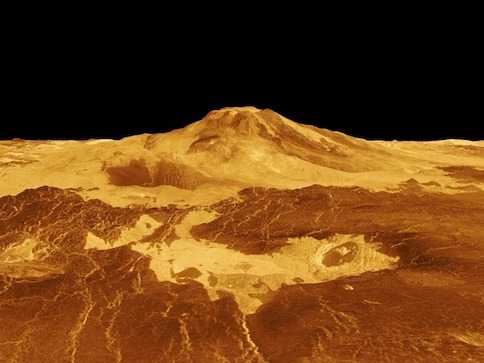
Perspective based on the radar images of the Magellan probe.
Venus may seem very malicious compared to Earth, but we thank this planet and all the information we have about it; because it is as a result of this information that it was possible to understand in more detail the greenhouse effect that affects us here on earth. One thing that is clear is that we don't need to become Venus-like for large CO2 emissions to be a problem to be dismayed about and take action on.
References
Advertising






Advertising