What color is a mirror?
Javier Pantoja, . Updated

To know the color of an object, we usually just look at it, but for mirrors it seems to be a bit more complicated: are they silver? White? Or all colors?
What is color?
To begin to answer our question we must first know what color is. To perceive light, we have photoreceptors in the eyes. The photoreceptors that detect color are called cones. They are photosensitive cells at the back of the eye, and different wavelengths of light stimulate different types of cones, allowing the brain to process colors.
- Type L: perceive long wavelengths (red color)
- Type M: perceive medium wavelengths (green color)
- Type S: perceive short wavelengths (blue color)
We perceive objects of a certain color because they reflect light at certain wavelengths while absorbing others. For example, an apple absorbs medium and short wavelengths (green, yellow, blue, purple) and reflects long wavelengths (red). The light that it reflects is what reaches our eyes and that is why we perceive it as red.

An apple reflects red light.
How do mirrors work?
Mirrors are made by depositing an extremely smooth layer of shiny metal (usually silver or aluminum) on the back of a piece of glass and covering it with protective paint. And they work through reflection, a phenomenon we all know.
The difference between an ordinary object and a mirror is that other objects are not as smooth as mirrors. A sheet of paper, for example, reflects all the light it receives and that is why we see it white, but, although at first glance it appears completely smooth, at the microscopic level it is rough unlike mirrors. Mirrors also reflect all the light they receive, but since their surface is smooth, they reflect it in an orderly manner.
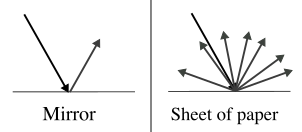
Specular and diffuse reflection.
A perfect mirror reflects a ray of light at an angle equal and opposite to the angle of incidence, which is called specular reflection; in contrast, rough objects, such as a sheet of paper, reflect light rays in a chaotic way, which is called diffuse reflection. Due to the way mirrors reflect light, we can see an image instead of just a white color.
Perfect mirrors don't exist
That said, we could say that, since mirrors reflect all the light they receive, they do not have a defined color of their own; it is given by the color of the object in front of them. But for that the mirror would have to be completely smooth, that is, a perfect mirror and, as we well know, there are no perfect things in our universe.
Mirrors actually do absorb some of the light they receive, but it is so little that it is imperceptible to the human eye. Researchers from the University of Granada (Spain) and the US Naval Academy conducted a study and concluded that mirrors reflect light best at wavelengths between 495 and 570 nanometers (which we perceive as green). Therefore, mirrors are slightly green.

We can make the green color more noticeable by placing two mirrors facing each other so that they reflect one another. This produces the so-called mirror tunnel, and we can notice how the tones become increasingly green and dark. This happens because each reflection absorbs more light, and less green light is absorbed than light of the other colors.